How it works in 30 seconds
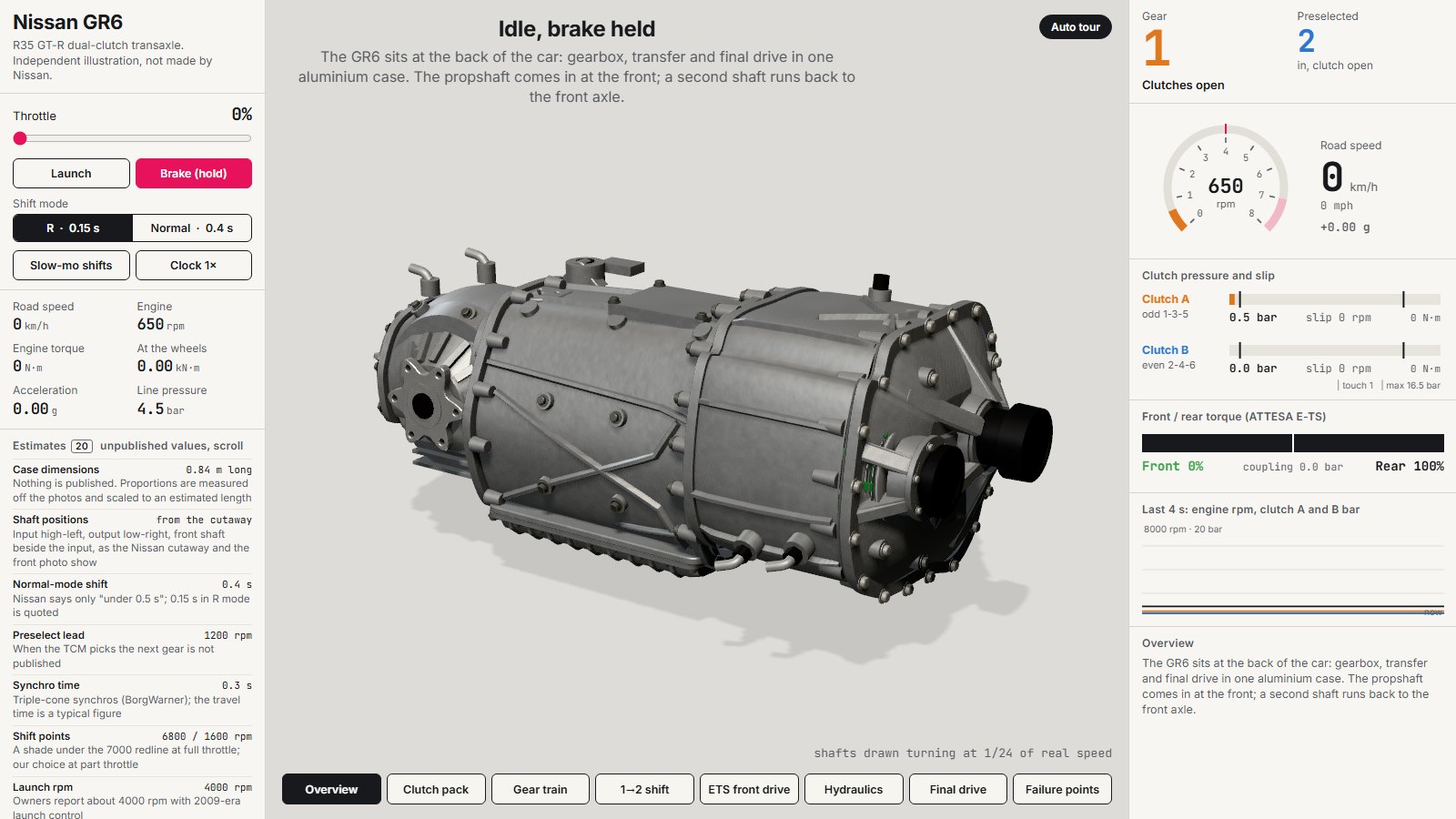
- Power comes in from the engine up front, down a propshaft and into the front of the case, at the back of the car.
- Two wet clutches sit behind it. Clutch A turns the solid inner input shaft, which carries 1st, 3rd and 5th. Clutch B turns the hollow outer shaft, which carries 2nd, 4th and 6th.
- While you pull in one gear, the computer has already locked the next gear on the other shaft, spinning and waiting for its clutch.
- To shift, one clutch lets go while the other clamps. For a split second they share the load, so the drive never actually stops.
- Behind the gears, the rear differential splits the drive between the rear wheels, and a second shaft beside the input sends some of it back up front when the rear tyres need help.
The parts
The twin wet clutch
Each clutch is a pack of six friction plates stacked between steel plates, running in oil. The oil carries the heat away, which is what lets the clutches slip hard during a launch without cooking. Oil pressure pushes a piston, the piston squeezes the stack, and more pressure means more grip.
Two input shafts, one inside the other
The solid inner shaft (clutch A) carries the odd gears and the hollow outer shaft (clutch B) carries the even gears. All six pairs of helical gears stay in mesh the whole time. A gear only drives when its sleeve locks it to the output shaft. First is 4.05 : 1 for the launch, and sixth is 0.80 : 1, an overdrive for cruising.
Synchronizers
On the shaft that isn't carrying anything, a sleeve slides across, three brass cones rub the next gear up to speed, and then the dog teeth lock. No clutch is needed there, because that shaft is free.
Hydraulics and the valve body
Everything runs on oil pressure. A pump on the clutch drum feeds the valve body underneath. Five solenoids set clutch A, clutch B, the line pressure and the shift forks, and three sensors read the pressures back, so the computer knows what is really happening.
Front drive (ATTESA E-TS)
A gear pair takes drive off the output shaft to the front output, and a multi-plate coupling decides how much the front wheels get. At a steady cruise it barely clamps and only about 2% goes forward (est.), so most of the time the GT-R is really rear drive. It sends more forward only when the rear tyres need help, up to a 50 : 50 split.
Rear differential
A 10-tooth pinion turns a 37-tooth ring gear, 3.7 : 1. The diff is a 1.5-way limited slip: on the power it clamps hard so both rear tyres push, and off the power it clamps more gently, so the car still turns in on the brakes.
Step by step: what happens during a shift
Take a full-throttle launch. With the brake held and the throttle floored, launch control holds the engine near 4,000 rpm (est.). Let go of the brake and clutch A grabs first gear, slipping while the car catches up. Pressure climbs and the slip shrinks to nothing as the clutch locks. Up front, the E-TS coupling is clamped hard, and around 40% of the drive goes to the front tyres (est.).
Meanwhile second gear is already locked on the outer shaft. The shift itself happens in two phases:
- The handover. Clutch A lets go while clutch B clamps. For a moment both share the load, so the drive never drops out.
- The speed change. The engine is still spinning at first-gear speed, so it is dragged down to second-gear speed through the slipping clutch, and the computer trims the engine's torque to help it along.
Once second is pulling, the box gets third ready on the free shaft, and every upshift repeats the same pattern. At the redline, first runs out around 60 km/h, second around 110 km/h and third just under 160 km/h (est.). Downshifts run the same two phases the other way round: a throttle blip spins the engine up to the lower gear's speed first, then the clutches trade.
How does it pick the moment? It reads your right foot. Pull away gently and it changes up early, around 2,200 rpm (est.). Floor it and it holds every gear to around 6,800 rpm (est.).
Key numbers
- 1Gears6 forward, dual clutch
- 2Clutches2 wet packs, 6 friction plates each
- 31st / 6th gear4.05 : 1 / 0.80 : 1
- 4Final drive3.7 : 1 (10 : 37), 1.5-way LSD
- 5Front driveabout 2% cruising, up to 50% (ATTESA E-TS)
- 6Shiftabout 0.15 s (est.)
- 7Launchabout 4,000 rpm (est.)
Figures marked (est.) are estimates from the model, not published Nissan numbers.
Common questions
How does a dual-clutch transmission work?
It splits the gears across two input shafts, each with its own clutch: odd gears on one, even gears on the other. The next gear is pre-selected on the idle shaft, and a shift is one clutch releasing while the other engages, so drive to the wheels never stops.
Is a dual-clutch transmission the same as an automatic?
No. A regular automatic drives through a fluid coupling and planetary gear sets. A dual clutch keeps a manual's simple, direct gear pairs and lets two computer-controlled clutches take the gap out of the shift.
How fast does the GT-R's GR6 shift?
In R mode the model shifts in about 0.15 seconds (a quoted figure; Nissan only says "under 0.5 s"), roughly a seventh of a second, split between the clutch handover and the engine speed change.
Is the Nissan GT-R always all-wheel drive?
It is rear-biased. At a steady cruise only about 2% of the drive goes to the front (est.). The ATTESA E-TS coupling sends more forward when the rear tyres need help, up to a 50 : 50 split.
What goes wrong with the GT-R GR6 transmission?
Rebuild shops see the same handful of failures: the inner clutch basket cracking on hard first-gear launches, torn clutch piston seals on early cars, pressure sensors that drift with heat, shift pistons that lose track and put the box in limp mode, and, at big power, a cracked differential housing.
Why does GR6 fluid matter so much?
The clutches, the solenoids and the gears all share one fluid. Dirty fluid makes solenoids stick and sends the box into limp mode, which is why owners change it far more often than the service schedule asks. The clutch touch point can also be relearned with a scan tool, which is how tuners get the stock clutches to hold more.
Watch the full breakdown
The narrated breakdown is coming
Get an email the day it's out.