How it works in 30 seconds
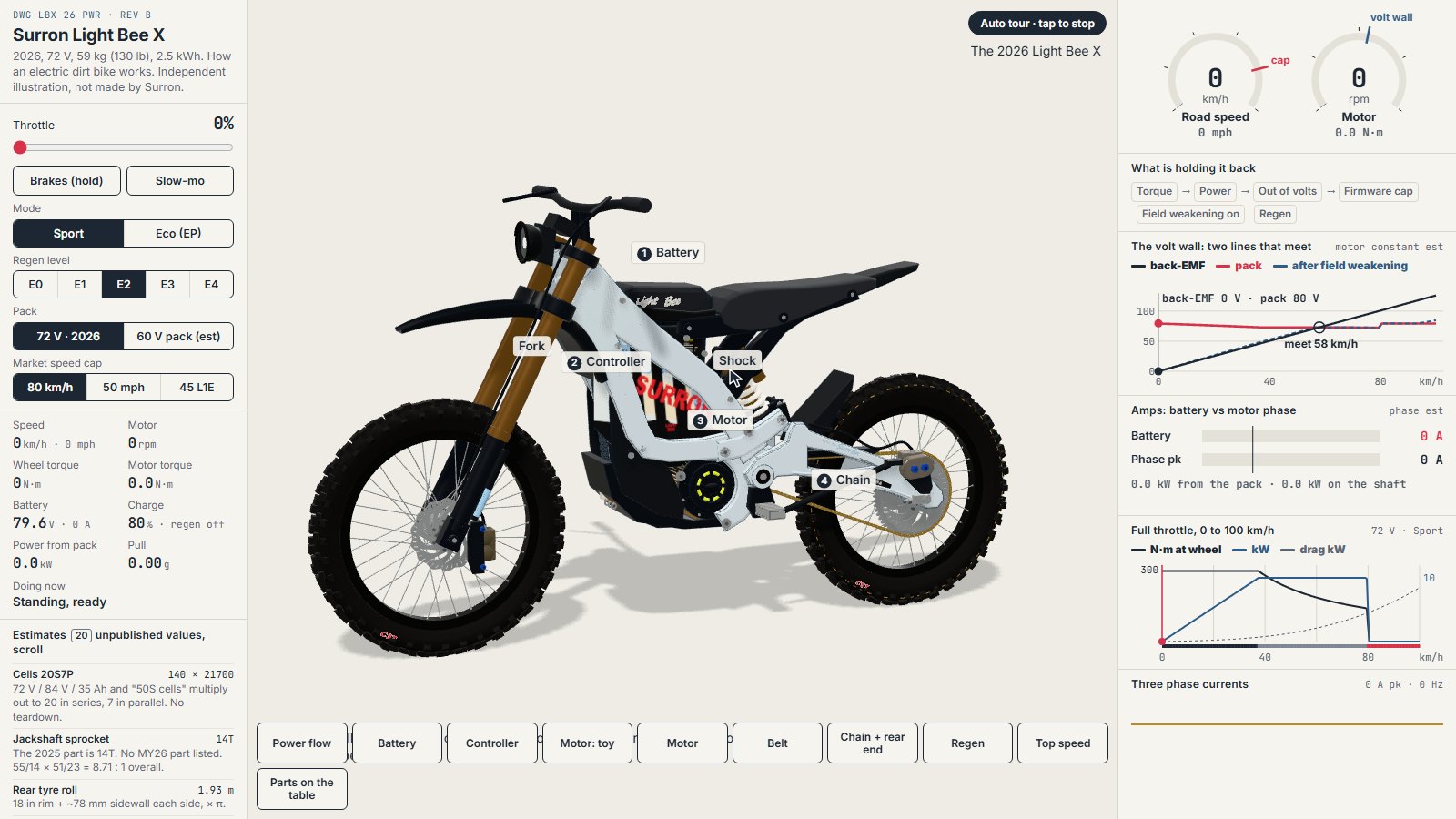
- Power starts in the battery, a sealed 72 V pack in the middle of the frame.
- It goes forward to the controller, up under the handlebars, which turns the battery's steady DC into three alternating currents for the motor.
- The motor sits down low. Its push comes from current, not revs, so it has full torque from a standstill.
- The motor spins a belt, the belt spins a short shaft at the swingarm pivot, and that shaft drives the chain to the rear wheel. Together they gear the motor down about 8.7 to 1 (est.).
- Let off the throttle and the motor turns into a generator: regen slows the bike and puts a little charge back in the pack.
The bike has one job: be light enough to throw around, but pull like a motorcycle.
The parts
The 72 V battery
A sealed aluminum box that lifts out the top; Surron quotes a 10-second swap. Inside are about 140 cells (est.), the same size as the ones in a lot of cordless drill packs, wired in 20 groups in series to make 72 V (84 V full). It holds 35 Ah, about 2.5 kWh.
An easy way to think about it: volts set how fast the motor can spin, amps set how hard it can push. The older bikes ran 60 V. The new pack holds almost the same energy, so the range barely changed. What changed is how fast the motor can spin, and that is what sets the top speed.
The controller
The battery gives it a steady DC voltage in one direction. The motor wants three alternating currents, one for each set of coils, taking turns. The controller chops up that steady voltage and builds those three currents on the fly. To aim them it uses field oriented control (FOC): it always knows where the motor's magnets are, so it can push them at the best angle.
It also works like a gearbox for electricity. At low speed it trades volts for amps. At launch on the model, the battery gives only about 21 A (est.) while the motor's phase current is around 257 A (est.). Same power in, far more push out.
The motor
Start with the toy version: one magnet on a shaft and three coils around it. Switch the coils on in turn and the magnet chases them around. That is all an electric motor really is. The real one is a permanent-magnet mid-drive with the same idea, just more of it: stronger magnets on the spinning part, rated to 180 °C, and copper coils around the outside. The fins are there because it is air-cooled.
A gas engine makes almost nothing at idle and needs a clutch to slip while it gets its revs. This motor's push comes from current, so the controller can give it full current with the bike standing still.
Belt and chain
The motor is small and spins fast; the back wheel is big and spins slower. So the drive is geared down twice: a belt from a 23-tooth pulley to a 51-tooth one, then a chain from a 14-tooth sprocket to the 55-tooth sprocket on the wheel. That multiplies the motor's twist about 8.7 times (est.).
On a bike this light, that is enough to lift the front, which is why the 2026 bike has wheelie control: a gyro feels the front coming up and backs the motor off. The middle shaft sits right on the swingarm pivot, so when the suspension moves, the chain stays the same length, like a door swinging on its hinge.
Regen
Roll off the throttle and the motor becomes a generator. The battery current goes negative: it slows the bike, like engine braking, and pulls a little charge back into the pack. There are five strengths, E0 to E4, and it switches itself off when the pack is full (above 95%) or hot, because there is nowhere for that energy to go.
Step by step: what sets the top speed
Take a full-throttle run from a standstill.
- Full push. Peak torque from zero, up to about 23 mph (37 km/h, est.), where the motor reaches its 10 kW.
- Power-limited. From here the faster it goes, the less it pushes. The gearbox for electricity now runs the other way: going faster takes more volts, which leaves fewer amps to push with.
- The volt wall. Every motor is also a generator, and the voltage it makes just by spinning pushes back against the battery. The faster it spins, the closer the two get. On the model they meet at about 4,300 motor rpm (est.).
- Field weakening. The controller spends some current fighting its own magnets to turn them down a little. Weaker magnets make less voltage, so the motor can spin faster. It loses some push but gets more revs.
- The cap. Then the firmware says stop: 50 mph in the US, 80 km/h elsewhere, at about 6,000 motor rpm (est.).
Holding that speed against the wind and the tyres only takes about 4.5 kW (est.), and the motor has 10. So it isn't out of power at the top; it's out of revs. That is why 72 V matters: the same motor on a 60 V pack (est.) hits the volt wall sooner and tops out around 71 km/h. It's also why Surron could gear the new bike shorter, for more pull, and still have it go faster.
Try it on the live model
- Press Power flow to watch the path from the battery to the rear wheel, or Auto tour to be walked through every part.
- Open Battery, Controller, Motor: toy, Motor, Belt and Chain + rear end to take each part apart, and Parts on the table to see it all laid out.
- Pull the Throttle from a standstill and watch Amps: battery vs motor phase: the battery gives a couple dozen amps while the motor gets many times that.
- Open Top speed, go to full throttle, and watch the two lines in The volt wall meet. What is holding it back names each limit as the bike reaches it.
- Switch the Pack to 60 V pack (est) and run it again: the lines meet sooner and it tops out lower.
- Open Regen, pick a Regen level from E1 to E4 (E0 is off), let off the throttle and watch the battery current go negative. Slow-mo, Sport / Eco and the Market speed cap (80 km/h, 50 mph, 45 km/h L1E) are there too.
Key numbers
- 1Battery72 V nominal, 35 Ah, 2.5 kWh
- 2Power10 kW peak, 4 kW rated
- 3Wheel torque295 N·m (217 ft-lb) peak
- 4Curb weight130 lb (59 kg)
- 5Top speed50 mph US / 80 km/h elsewhere
- 6Drivebelt 23 : 51, then chain 14 : 55
- 7Overall ratioabout 8.7 : 1 (est.)
- 8Cellsabout 140, 20 in series (est.)
- 9Motor at top speedabout 6,000 rpm (est.)
Figures marked (est.) are estimates from our own working and the model, not published Surron numbers.
Common questions
How does an electric dirt bike work?
A battery feeds a controller, the controller turns the battery's DC into three alternating currents for the motor, and the motor drives the rear wheel through a belt and a chain. There is no clutch and no gearbox, and the motor has full torque from a standstill.
How fast does a 2026 Surron Light Bee X go?
Surron rates it at 50 mph in the US and 80 km/h elsewhere. The firmware sets that cap, at about 6,000 motor rpm (est.). Holding that speed only takes about 4.5 kW (est.) of the motor's 10 kW, so the limit is revs, not power.
What changed with the 72 V battery?
The 2026 pack is 72 V instead of 60 V, with almost the same energy (2.5 kWh), so the range barely changed. The higher voltage lets the motor spin faster before it meets the volt wall, which is how the bike got shorter gearing and a higher top speed at the same time.
Why does a Surron have a belt and a chain?
To gear the small, fast motor down to the big, slower rear wheel in two steps, about 8.7 to 1 overall (est.). The short shaft between them sits on the swingarm pivot, so the chain stays the same length as the suspension moves.
Does a Surron have regenerative braking?
Yes. Letting off the throttle turns the motor into a generator that slows the bike and puts a little charge back in the pack. There are five levels, and it switches off when the pack is above 95% or hot.
Watch the full breakdown
- 0:00 Intro
- 0:26 How does an electric dirt bike work?
- 1:07 What does the 72-volt battery actually do?
- 1:56 What does the controller do when you twist the throttle?
- 2:53 How does the motor make full torque at zero RPM?
- 3:48 Why does it need a belt and a chain?
- 4:42 What happens when you let off the throttle?
- 5:14 What really sets a Surron's top speed?